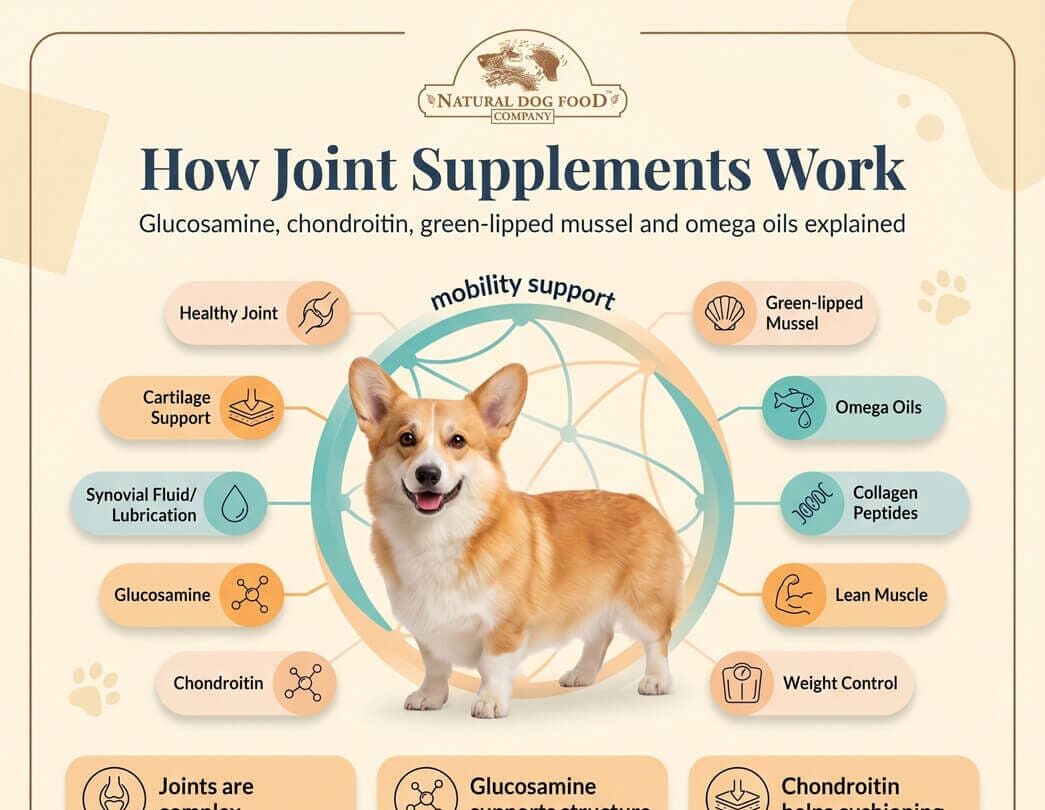

Joint supplements are often talked about as though they are all doing the same thing. A dog becomes stiff, slows down on walks, struggles after rest or hesitates before jumping, and owners naturally start looking for something to help. The words then begin to appear: glucosamine, chondroitin, green-lipped mussel, collagen, omega oils.
What do joint supplements actually do?
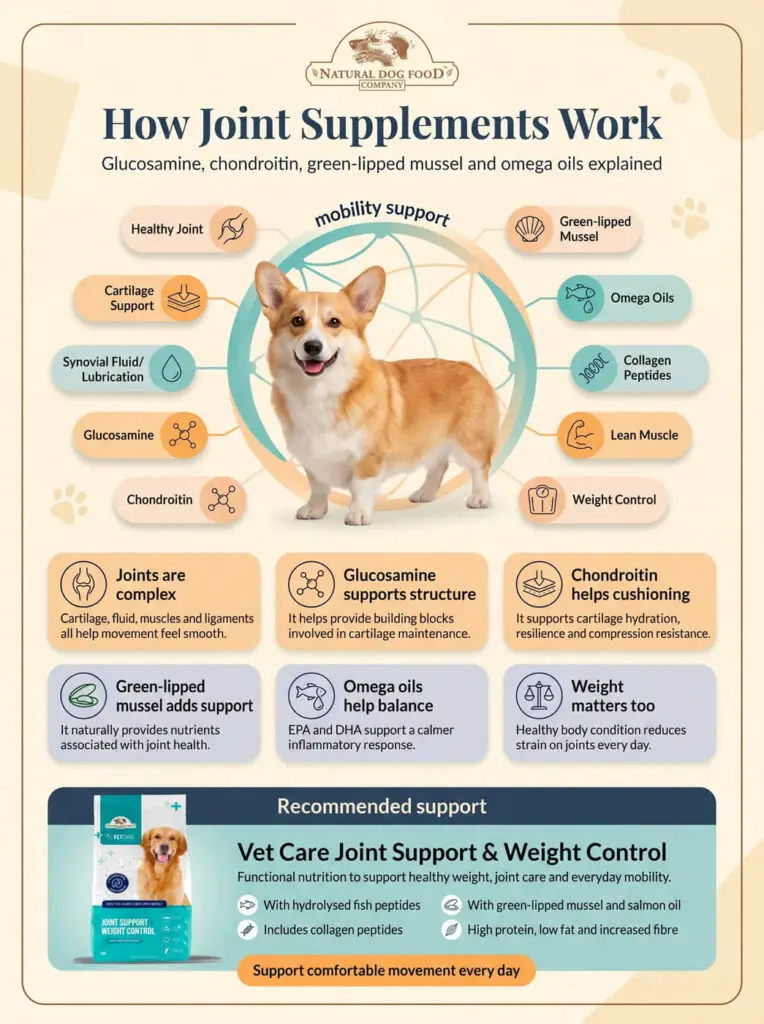
To understand joint supplements, it helps to understand the joint itself. A healthy joint is not simply two bones meeting. It is a carefully engineered structure made up of cartilage, synovial fluid, ligaments, tendons, muscles and connective tissue. Cartilage covers the ends of the bones and helps create a smooth, cushioned surface. Synovial fluid lubricates the joint, reducing friction as the dog moves. Ligaments stabilise the joint, while muscles help control movement and absorb force.
When everything is working well, movement looks effortless. The dog rises easily, walks freely, turns comfortably and recovers well after exercise. When joint health begins to decline, movement can become less smooth. Owners may notice stiffness after rest, reluctance to climb stairs, reduced enthusiasm for walks, altered posture or a dog who seems more cautious than usual.
One of the most common joint problems in dogs is osteoarthritis. This is a degenerative joint condition where cartilage, bone and surrounding tissues become affected over time. It is not simply “wear and tear”. Osteoarthritis involves inflammation, cartilage breakdown, changes in the underlying bone and altered joint mechanics. Treatment often focuses on multimodal management, including weight control, controlled exercise, medication where needed and nutritional support such as EPA-rich diets.
Joint supplements in dog food
Glucosamine
One of the best-known joint supplement ingredients. As an amino sugar, glucosamine helps the body produce glycosaminoglycans, important components of cartilage and joint fluid. In simple terms, the body uses glucosamine as one of the building blocks for maintaining cartilage structure.
Chondroitin
Commonly paired with glucosamine. Chondroitin sulphate is also part of the cartilage matrix. It helps cartilage hold water, which is important because cartilage needs resilience and compression resistance. Healthy cartilage is not dry and brittle. It has a hydrated, springy quality that allows it to cushion force.
That distinction matters. Joint supplements are not the same as anti-inflammatory pain medication. They do not usually produce an overnight change. If they help, they tend to work gradually as part of longer-term joint support. They are best thought of as nutritional tools that support the tissues involved in movement, not as a replacement for veterinary treatment when a dog is painful or lame.
Green-lipped mussels
Another ingredient often used in joint support. It comes from the New Zealand green-lipped mussel, Perna canaliculus, and is valued because it contains a mixture of naturally occurring nutrients, including omega-3 fatty acids, glycosaminoglycans and other compounds associated with joint health. Research in dogs has found that green-lipped mussel may help support dogs with chronic orthopaedic pain, although owners should not treat it as a direct substitute for veterinary pain relief where dogs need it.
Omega oils
Omega-3 fatty acids, particularly EPA and DHA from marine sources, are important because they influence inflammatory pathways. Inflammation is part of the body’s normal repair and defence system, but in osteoarthritis and joint irritation, ongoing inflammation can contribute to discomfort, stiffness and reduced mobility. EPA-rich diets and EPA supplementation have been associated with improved gait and mobility in dogs with osteoarthritis.
The science here involves cell membranes and signalling molecules. Omega-6 and omega-3 fatty acids are incorporated into cell membranes. When inflammation is triggered, the body uses these fatty acids to produce chemical messengers. Some are more inflammatory, while others are less so or help resolve inflammation. By increasing marine omega-3 intake, particularly EPA and DHA, the balance of these signalling molecules can shift towards a calmer inflammatory response.
Collagen
Another important part of joint health. It is a major structural protein in connective tissues, including cartilage, tendons, ligaments and bone. Collagen peptides are smaller fragments of collagen that provide amino acid building blocks for tissue maintenance. They do not simply travel straight to the joint and become new cartilage, but they can form part of a nutritional strategy that supports the body’s normal repair and renewal processes.
Does weight and exercise affect joints in dogs?
Weight plays one of the most important roles in joint care, but owners sometimes overlook it because they naturally focus on supplements. A heavier dog places more mechanical load through the joints with every step. Extra body fat can also contribute to inflammatory signalling, meaning weight management is not only about pressure on the joints, but about the internal environment around them. Consensus guidance on canine osteoarthritis recognises weight management and nutritional support, including omega-3 fatty acids and joint-focused diets, as important parts of care.
This is why joint support should not be thought of as a single ingredient added on top of everything else. A dog’s mobility depends on cartilage, inflammation control, muscle condition, body weight, exercise, recovery and daily nutrition. If a dog is carrying excess weight, no supplement can fully overcome the extra strain placed on the joints.
Exercise matters too. Too little movement can lead to loss of muscle, poorer joint support and increased stiffness. Too much high-impact activity can aggravate sore joints an so regular, controlled movement helps many dogs: steady walks, sensible play, good footing and avoiding repeated jarring when mobility is already compromised.
For dogs needing everyday mobility support, the most useful approach is often a combined one: appropriate vet advice, good body condition, controlled exercise and a diet that supports joint tissues without encouraging weight gain.
The best dog food for joints and weight
Natural Dog Food Company Vet Care Joint Support & Weight Control includes hydrolysed fish peptides, collagen peptides, green-lipped mussel, salmon oil and L-carnitine. It is high in protein at 29%, low in fat at 9%, and contains increased fibre at 8.5% to help support satiety. The recipe is designed to support healthy weight, joint care and everyday mobility, while helping dogs maintain lean muscle and encouraging healthy fat metabolism.
Food is not a replacement for veterinary care. A vet should asses a dog who is lame, painful, struggling to rise, reluctant to exercise, yelping, swollen around a joint or suddenly less mobile. Joint supplements and functional diets can be valuable, but pain and lameness deserve proper investigation.
A healthy joint is not maintained by one nutrient alone. It depends on structure, lubrication, controlled inflammation, strong supporting muscles and a body weight the joints can comfortably carry. Glucosamine, chondroitin, green-lipped mussel, collagen and omega oils all approach the problem from slightly different angles. When owners combine good nutrition, weight control and appropriate exercise, they can form part of a thoughtful plan to help dogs stay active, comfortable and ready to enjoy their day.
For more blog posts, visit our blog page!
Keep in touch: