
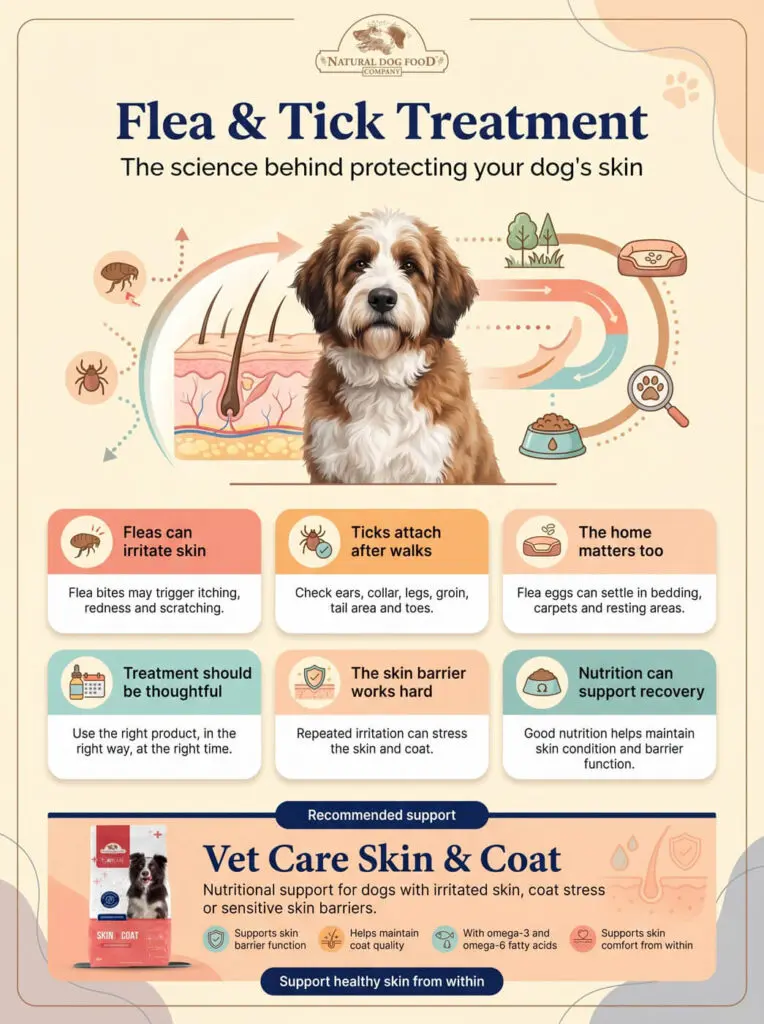
Fleas and ticks are easy to think of as a simple nuisance, but for dogs they can be far more than that. A dog may start scratching more than usual, nibbling at their coat, licking sore areas or rubbing against furniture. The skin may look red, flaky or irritated. Sometimes there are small scabs, areas of hair loss or tiny black specks in the coat. Sometimes the first clear sign is a tick found attached to the skin after a walk.
Although fleas and ticks are often grouped together, they are very different parasites. Fleas are insects. They are small, fast-moving and feed on blood. Ticks are arachnids, more closely related to spiders and mites. They attach to the skin and feed slowly over a longer period. Both can irritate the skin, cause discomfort, can create wider health concerns if not managed properly.
A flea pierces the skin and takes a blood meal and as it feeds, saliva is introduced to the skin. This saliva contains compounds that help the flea feed effectively, but it can also irritate the dog’s immune system. In some dogs, even a small number of flea bites can trigger flea allergic dermatitis, where the immune response becomes exaggerated. The result can be intense itching, redness, scabbing and self-trauma from scratching, chewing or licking.
Ticks feed in a different way. A tick attaches its mouthparts into the skin and remains fixed while it feeds. During this process, tick saliva helps the tick stay attached and continue feeding. The bite itself can cause local irritation, swelling or soreness, but the greater concern is that some ticks can carry infectious organisms such as Lymes disease. Not every tick is infected, and not every bite causes disease, but prompt removal reduces the time available for transmission.
Flea and tick life cycles
Fleas are particularly difficult because their life cycle does not happen only on the dog. Adult fleas live on the animal and feed, but eggs can fall into the surrounding environment. These eggs develop into larvae and pupae in carpets, bedding, soft furnishings and the areas where a dog rests. This is why a flea problem can seem to disappear and then return. The adult fleas seen on the coat are only one part of the population.
Effective flea control therefore means breaking the life cycle, treating the dog is important, but so is the environment. Wash bedding and ensure resting areas are cleaned, other pets in the household should also be considered. Flea eggs, larvae and pupae can continue developing away from the dog, so a half-hearted approach can leave the problem ticking away quietly in the background.
Ticks are usually picked up outdoors rather than from the home. Long grass, woodland, heathland, fields and areas with wildlife can all increase exposure. Ticks often attach in warm or hidden places such as around the ears, under the collar, beneath the legs, around the groin, near the tail or between the toes. Checking the coat after walks is one of the simplest and most useful habits an owner can build.
Flea and tick treatments for dogs
Flea and tick treatments work in several ways, depending on the active ingredient and the form of the product. Some are given orally as tablets or chews, applied to the skin as spot-on liquids or are worn as collars. Some products kill parasites after contact or feeding, while others also have a repellent effect.
Many modern treatments act on the parasite’s nervous system. Nerve cells communicate using electrical and chemical signals. Certain flea and tick treatments interfere with those signals in insects and arachnids, leading to paralysis and death of the parasite. The exact mechanism depends on the active ingredient, but the principle is targeted disruption of parasite nerve function when the product is used correctly.
Different types of treatments
Flea treatments are applied to the skin, usually at the back of the neck or between the shoulder blades. Depending on the product, the active ingredient may spread through the oils of the skin and coat, or may be absorbed more systemically. This is why correct application matters. The liquid needs to reach the skin, not simply sit on top of the hair. Bathing, swimming or applying the product incorrectly can reduce how well some treatments perform.
Oral treatments work from within the body. The dog swallows the product, the active ingredient is absorbed, and fleas or ticks are exposed when they feed. This can be useful for dogs who swim frequently or where topical application is difficult, but the correct product should always be chosen according to the dog’s weight, age, health and lifestyle.
Collars work by releasing active ingredients over time. They must fit correctly and remain in contact with the coat and skin to perform properly. A collar that is loose, damaged, dirty or past its effective period may not provide reliable protection.
Responsible parasite control is becoming increasingly important. In April 2026, the Veterinary Medicines Directorate opened a call for evidence on the environmental impact of flea and tick treatments containing fipronil or imidacloprid, particularly in relation to residues or effects in the environment and watercourses. The review is also considering whether professional advice at the point of sale could support more responsible use and disposal.
This does not mean dogs should be left unprotected, fleas and ticks can cause genuine welfare problems. It does mean treatment should be thoughtful rather than automatic. The right product, used at the right time, in the right way, is better than guesswork. Owners should avoid unnecessary overuse, follow instructions carefully and dispose of products responsibly.
How fleas and ticks affect a dog’s skin
The skin is where many of the visible effects of fleas and ticks are seen. Bites can damage the skin barrier, trigger inflammation and lead to itching. Repeated scratching can break the surface of the skin, making it easier for bacteria or yeast to take advantage of the irritated area. Hair loss, scabbing and dull coat condition often follow because the skin is under stress.
The skin barrier is not just a surface layer. It is a living protective system made up of cells, oils, structural proteins and immune defences. It helps retain moisture, reduce irritation and protect the body from the outside world. When fleas or ticks repeatedly irritate the skin, that barrier has to work harder to repair itself.
Can diet help with fleas and ticks?
Nutrition can support recovery after fleas and ticks. Protein provides amino acids for tissue maintenance and repair. Essential fatty acids help maintain the skin’s moisture barrier and support coat quality. Omega-3 fatty acids, including EPA and DHA, are associated with natural anti-inflammatory support, while omega-6 fatty acids such as linoleic acid and GLA play important roles in skin barrier function and moisture retention.
Food is not a flea or tick treatment, but it can help support the dog’s skin after irritation. Natural Dog Food Company Vet Care Skin & Coat has been developed with this purpose in mind. By using hydrolysed salmon and white fish protein, collagen peptides, salmon oil, algae, borage oil and carefully balanced omega-3 and omega-6 fatty acids to support skin condition, coat quality and barrier function. For dogs recovering from a difficult bout of fleas, or those whose skin is easily irritated, it can be a sensible nutritional choice alongside appropriate parasite control.
Owners should seek veterinary advice if a dog has severe itching, broken skin, swelling around a tick bite, repeated flea problems, lethargy, lameness, fever, loss of appetite or any unusual symptoms after a bite. A vet can help identify whether there is an infestation, an allergic reaction, infection or another underlying skin issue.
Flea and tick control is not just about removing parasites. It is about protecting the skin, reducing inflammation, supporting comfort and helping the dog feel settled in their own body again. When treatment is responsible, observation is regular and nutrition supports the skin from within, dogs have a better chance of staying comfortable, protected and ready to enjoy their day.
For more helpful articles, visit our blog page!
For more blog posts, visit our blog page!
Keep in touch: